
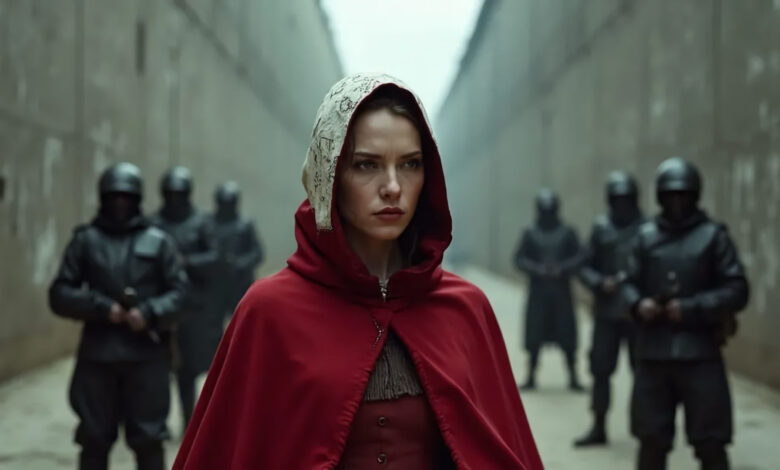
Author: Margaret Atwood
Published: 1985
Genre: Dystopian Fiction / Feminist Sci-Fi / Political Allegory
Setting: Near-future totalitarian America, renamed Gilead
⭐ Why It Matters
The Handmaid’s Tale is one of the most iconic and chilling dystopian novels of the 20th century. Set in a society where women have been stripped of their rights and reduced to reproductive roles, it serves as a powerful warning about the fragility of freedom — and the consequences of extremism, control, and complicity.
Studied in A-Level Literature and university syllabuses across the UK, it’s also grown in popularity due to its successful TV adaptation.
👥 Main Characters
- Offred – The narrator and “Handmaid” assigned to produce a child for her Commander. Her real name is never confirmed.
- Serena Joy – The Commander’s wife. Once a vocal advocate for traditional values, now bitter and powerless.
- The Commander – A high-ranking official in Gilead. Ambiguous morality; breaks the rules he helped create.
- Nick – The family’s driver. Offred’s secret lover. May be involved with the resistance.
- Moira – Offred’s rebellious best friend from before Gilead. A symbol of defiance.
- Luke – Offred’s husband before the regime. His fate is unknown.
- Aunt Lydia – An enforcer of Gilead’s rules, who indoctrinates Handmaids under the guise of “protection.”
📚 Plot Summary
🔹 Before Gilead – A Free Woman
Offred recalls her life before the regime: married to Luke, mother to a daughter, working, reading, and independent. When Gilead rises to power through a violent coup, women are stripped of their jobs, rights, and identities. Her child is taken, and she’s separated from Luke.
🔹 Gilead – The New Normal
Now known only as “Offred” (literally Of-Fred, her Commander’s name), she is a Handmaid — a woman forced to bear children for elite couples in a society facing infertility.
Her life is strictly controlled: reading is banned, movement restricted, and “Ceremonies” (ritualised rape by the Commander) are monthly obligations.
🔹 Secret Rebellion
Despite the threat of public hangings and brutal punishments, Offred begins taking risks:
- The Commander invites her to secret Scrabble games
- He gives her banned items like lotion and magazines
- She begins an illicit relationship with Nick, possibly out of love or desperation
- Serena Joy arranges the affair, hoping Offred will conceive (as the Commander may be sterile)
She also learns of “Mayday”, a hidden resistance movement — but it’s unclear who to trust.
🔹 Climax – Betrayal or Rescue?
Offred’s predecessor, the previous Handmaid, took her own life. Offred, now under surveillance, fears she’s next.
At the end, black vans arrive to take her away. Nick tells her to trust him — that it’s the resistance, not the regime. Offred steps into the unknown, her fate unresolved.
🔹 Epilogue – History Looks Back
In a postscript set centuries later, academics discuss “The Handmaid’s Tale” as a found recording, debating its accuracy. This ending reframes the entire book as a historical document, suggesting that regimes rise and fall — but human rights remain fragile.
🧠 Themes & Takeaways
- Power & Oppression – Gilead uses religion and patriarchy to justify systemic control.
- Identity & Language – Women’s names, voices, and autonomy are erased.
- Resistance vs Complicity – Quiet acts of rebellion can be just as powerful as overt ones.
- Fertility & Control – The female body becomes a tool of the state.
- Memory & Truth – Offred’s story is filtered through trauma, fear, and unreliable memory.