
Author: Mary Shelley
Published: 1818
Genre: Gothic Novel / Science Fiction / Romanticism
Setting: 18th-century Europe, including Switzerland, Germany, the Arctic
⭐ Why It Matters
Mary Shelley was just 18 when she conceived of and began writing Frankenstein, which was published anonymously whe she was still only 20. The book is often called the first true science fiction novel. But it’s also a Gothic tragedy — a tale of hubris, creation, alienation, and revenge. More than just a monster story, it explores what it means to be human… and how society creates its own monsters.
It’s widely taught on the AQA, OCR, and Edexcel syllabuses in the UK.
👥 Main Characters
- Victor Frankenstein – A brilliant but obsessive scientist who creates life, then rejects it.
- William Frankenstein – Victor’s youngest brother, whose murder marks the beginning of the Creature’s revenge against his creator.
- Justine Moritz – A trusted member of the Frankenstein household who is wrongly convicted of William’s murder.
- The De Lacey Family – An impoverished French family secretly observed by the Creature. Their kindness towards one another teaches him about love, loyalty and human society.
- Safie – Felix De Lacey’s fiancée. As Felix teaches her to speak and read, the hidden Creature learns alongside her.
- The Creature (often wrongly called “Frankenstein”) – Victor’s unnamed creation. Intelligent, sensitive, and ultimately violent after repeated rejection.
- Elizabeth Lavenza – Victor’s cousin and fiancée.
- Henry Clerval – Victor’s best friend and moral contrast.
- Alphonse Frankenstein – Victor’s father, supportive but blind to his son’s inner torment.
- Captain Walton – An explorer whose letters frame the novel, and who meets Victor at the end of his life.
📚 Plot Summary
🔹 Framed by Letters
The novel begins with Captain Walton’s letters to his sister. He’s leading a dangerous Arctic expedition when he encounters a weakened Victor Frankenstein, who begins telling him his tragic life story. But Walton is more than a convenient narrator. Like Victor, he is ambitious, isolated and willing to endanger others in pursuit of extraordinary achievement. Victor recognises this similarity and tells his story partly as a warning. The novel is therefore constructed as a series of narratives within narratives: Walton records Victor’s account, while Victor later recounts the Creature’s own story. Each narrator offers a different perspective, leaving readers to decide how much sympathy and trust each one deserves.
🔹 The Spark of Life
Victor, obsessed with science, studies at university and becomes fascinated with reanimating dead tissue. He secretly creates a living being, spending time in charnel houses, dissecting rooms and slaughterhouses in order to do so — but is horrified by its appearance and abandons it immediately.
The shock of what he has done causes Victor to suffer a prolonged nervous collapse, during which Henry Clerval nurses him back to health. Before Victor can return fully to ordinary life, he receives news that his young brother William has been murdered near Geneva. On his journey home, Victor sees the Creature near the place where William died and immediately suspects the truth.
A miniature belonging to William is discovered in the clothing of Justine Moritz, a beloved member of the Frankenstein household. Although she is innocent, Justine is pressured into making a false confession and is executed. Victor remains silent because he believes no one will accept his story about the Creature. His refusal to speak makes him partly responsible for Justine’s death and demonstrates that his abandonment of the Creature continues to harm innocent people.
🔹 The Creature’s Awakening
Left to fend for himself, the Creature experiences the world in isolation, learning speech, morality, and emotion by observing a rural family in secret.
The family are the De Laceys: the blind elderly father, his son Felix and his daughter Agatha. The Creature secretly gathers firewood for them and becomes emotionally invested in their happiness. When Safie arrives, Felix begins teaching her French, allowing the Creature to learn language, history, politics and social customs at the same time.
He also discovers several books, including Paradise Lost, Plutarch’s Lives and The Sorrows of Young Werther. These works shape his understanding of humanity and of himself. He identifies with both Adam, a creation abandoned by his maker, and Satan, an outcast consumed by envy and resentment. After reading Victor’s journal, he also learns that his creator regarded him with horror from the moment he came to life.
He tries to approach them — but is violently rejected. The rejection is particularly painful because the blind De Lacey initially listens to him with kindness. When Felix returns and sees the Creature beside his father, however, he attacks and drives him away. The family abandons the cottage, destroying the Creature’s hope of joining them, and he burns the empty building in despair.
Even after this, the Creature briefly attempts to help humanity by rescuing a girl from drowning, only to be shot by the man accompanying her. Repeated violence persuades him that people will always judge him by his appearance. His desire for affection gradually gives way to a determination to make Victor experience the same isolation and loss.
He confronts Victor and demands a companion, saying he has become a monster because he was treated like one.
🔹 Creation & Destruction
Victor reluctantly agrees to create a female companion on the condition that the Creature leaves Europe and lives apart from humanity. He begins the work on a remote island in the Orkneys, but becomes increasingly troubled by what he might unleash. The female creature may reject her intended companion, become more violent than him or reproduce, creating what Victor imagines could become an entire race of beings.
When Victor destroys the unfinished body, the Creature watches through a window and vows that he will be with Victor on his wedding night. Victor assumes that the threat is directed against him. After disposing of the remains at sea, he is blown off course and reaches Ireland, where he is arrested for murder. The victim is Henry Clerval, strangled by the Creature as another act of revenge.
Victor is eventually cleared and returns home. He marries Elizabeth but, still believing that he is the Creature’s intended victim, leaves her alone while he searches for his enemy. The Creature instead murders Elizabeth in the bridal chamber. Victor’s inability to understand the warning completes the destruction of the family and future he had hoped to protect.
🔹 Pursuit & Regret
Overcome by grief after Elizabeth’s murder, Victor suffers another loss when his father dies shortly afterwards. He reports the Creature to a magistrate, but his account is treated as the product of an unbalanced mind. With no family life left to preserve, Victor vows to devote himself entirely to destroying his creation.
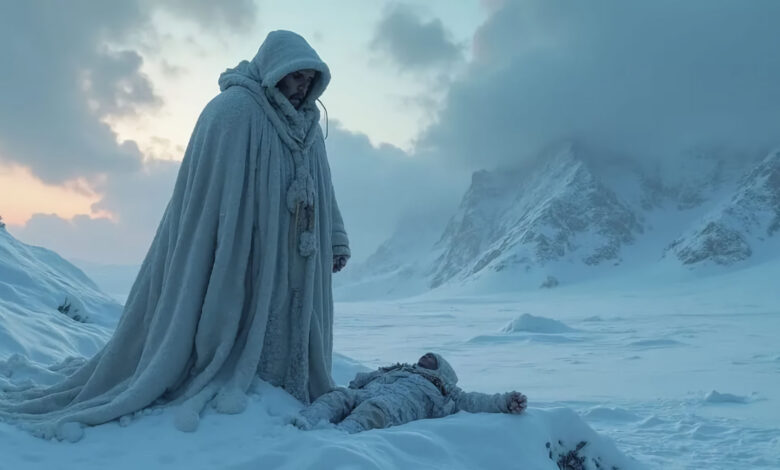
The pursuit stretches across Europe and into Russia. The Creature leaves messages, tracks and occasional supplies behind, ensuring that Victor remains alive long enough to continue the chase. Their roles have now reversed: the abandoned creation controls his creator, while Victor becomes as isolated and obsessive as the being he hunts. The trail eventually leads onto the Arctic ice, where Victor collapses and is rescued by Walton’s crew.
Victor dies, warning Walton not to follow his path of obsession.
The Creature appears over Victor’s body, mourns his creator, and vows to end his own life. He disappears into the icy wilderness.
Walton ultimately makes the choice that Victor could not. When his frightened crew asks him to abandon the expedition, he agrees to return home rather than sacrifice their lives for his ambition. The Creature, meanwhile, expresses genuine grief over Victor’s death but does not deny the suffering he has caused. Shelley ends without offering a simple hero or villain: Victor is both creator and destroyer, while the Creature is both a victim of rejection and the author of terrible crimes.
🧠 Themes & Takeaways
- Creation & Responsibility – Victor plays God, but refuses to care for his creation, showing that the true “monster” may be the one who abandons, not the one created.
- Isolation & Loneliness – Both Victor and the Creature suffer from alienation, which leads to madness and violence.
- Science & Ethics – The novel questions the moral boundaries of scientific discovery.
- Appearance vs Reality – The Creature is physically horrifying, but begins as emotionally and morally innocent.
- Nature & the Sublime – The natural world is a refuge and a mirror for emotional states.
- Parenting & Rejection – The Creature’s rage is rooted in Victor’s failure as a father figure.
Continue with the book
 Frankenstein: Penguin ClassicsView on Amazon→
 Frankenstein: Kindle EditionView on Amazon→
 Frankenstein: 4K UHD & Blu-RayView on Amazon→
As an Amazon Associate, Fictiq earns from qualifying purchases.