Author: George Orwell
Published: 1945
Genre: Political Allegory / Satirical Novella / Dystopian Fiction
Level: GCSE
Setting: Manor Farm, later renamed Animal Farm, in rural England
⭐ Why It Matters
Animal Farm uses the apparently simple story of a farmyard rebellion to examine how revolutions can be corrupted by those who gain control of them. George Orwell transforms major events from the Russian Revolution and the rise of Joseph Stalin into an accessible fable about power, propaganda, inequality and political betrayal.
The novella is not an argument against equality or collective action. Orwell was a democratic socialist who opposed totalitarianism and wanted to show how revolutionary ideals could be manipulated by an authoritarian ruling class. The animals overthrow one oppressor, but their failure to protect truth, education and shared political responsibility allows another form of oppression to replace it.
Orwell described the book as the first work in which he consciously attempted to combine political and artistic purpose. Its short length, memorable characters and deceptively straightforward language make it accessible, but its treatment of propaganda, historical revision and the corruption of language gives it considerable depth. It remains a set text on several UK English Literature courses, including AQA GCSE.
👥 Main Characters
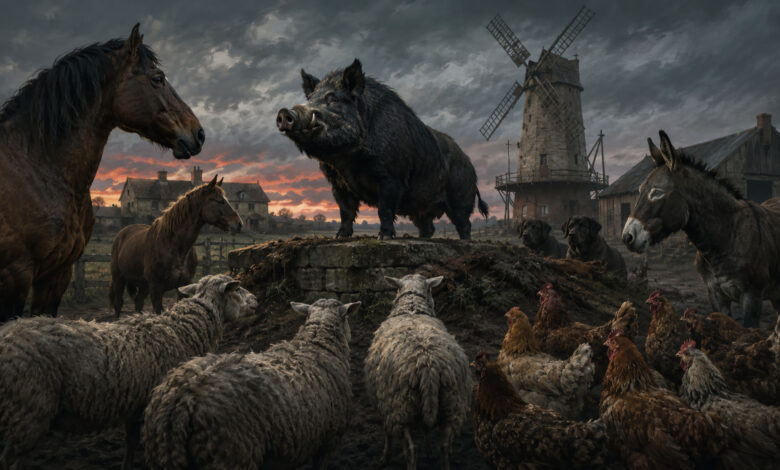
- Napoleon – A large Berkshire boar who gradually becomes the farm’s authoritarian ruler. He represents Joseph Stalin and the corrupting influence of unchecked power.
- Snowball – An intelligent and energetic pig who helps organise the rebellion. His rivalry with Napoleon and eventual exile broadly parallel the fate of Leon Trotsky.
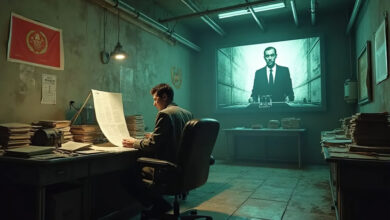
- Squealer – Napoleon’s persuasive spokesman, who uses statistics, misleading explanations and outright lies to justify every change in policy.
- Boxer – A powerful and loyal cart-horse whose enormous capacity for work sustains the farm. His trust in Napoleon makes him tragically vulnerable.
- Clover – A compassionate mare who senses that the rebellion is being betrayed but lacks the education and confidence to challenge the pigs effectively.
- Benjamin – A cynical and highly intelligent donkey who can read as well as the pigs but believes that life will remain miserable regardless of who rules.
- Old Major – An elderly prize boar whose vision of a society without human exploitation inspires the rebellion.
- Mr Jones – The neglectful and frequently drunken owner of Manor Farm, driven away by the animals.
- Mollie – A vain young mare who values sugar, ribbons and human attention more than the sacrifices demanded by the revolution.
- Moses – Mr Jones’s tame raven, who tells the animals about Sugarcandy Mountain, a paradise supposedly awaiting them after death.
- The Dogs – Puppies secretly raised by Napoleon and transformed into his private security force.
📚 Plot Summary
🔹 Old Major’s Dream
Old Major gathers the animals in the barn after Mr Jones has gone to bed. He describes human beings as parasites who consume what animals produce while contributing nothing themselves. Animals provide milk, eggs, strength and eventually their own lives, yet receive only enough food to keep them working.
He urges the animals to overthrow human rule and create a society in which every animal is free and equal. He also warns them never to adopt human habits or become like their former masters. The meeting ends with the animals singing “Beasts of England”, a revolutionary song celebrating the freedom they hope future generations will enjoy.
Old Major dies three nights later, but his teachings are developed into a political system called Animalism. The pigs, regarded as the farm’s most intelligent animals, take responsibility for explaining its principles. Snowball and Napoleon emerge as the most influential organisers, while Squealer proves particularly skilled at persuading doubtful animals.
🔹 The Rebellion
The rebellion occurs sooner than expected. Mr Jones neglects to feed the animals, who eventually break into the food store. When Jones and his workers attempt to beat them, the hungry animals fight back and drive the humans from the farm.
The animals destroy many of the objects associated with their former exploitation and rename Manor Farm as Animal Farm. The pigs reduce the principles of Animalism to Seven Commandments, which are painted on the barn wall. The most important declares that all animals are equal.
The first harvest is successful, and the animals work with greater enthusiasm because they believe they are now working for themselves. Boxer becomes especially valuable, approaching every difficulty with increased effort and unquestioning determination.
Inequality nevertheless appears almost immediately. The farm’s milk disappears, and the pigs reserve the apples for themselves. Squealer claims that pigs require this food because their brainwork is essential. He also warns that Jones could return if the pigs fail, establishing a pattern in which fear is used to silence objections.
🔹 Snowball and Napoleon Compete
Snowball tries to educate the animals, creates committees and promotes the rebellion to neighbouring farms. Most of his projects fail, but he succeeds in teaching several animals to read. Because many cannot remember the Seven Commandments, he reduces Animalism to the slogan “Four legs good, two legs bad”.
Jones and several neighbouring farmers later attempt to recapture Animal Farm. During the Battle of the Cowshed, Snowball organises the defence and is wounded while charging at Jones. The humans are driven away, and Snowball and Boxer receive medals for their bravery.
Tension between Snowball and Napoleon continues to grow. Snowball proposes building a windmill that could generate electricity and reduce the animals’ workload. Napoleon opposes the idea. During the meeting at which the animals are expected to vote, Napoleon summons nine large dogs that he secretly raised from puppies. They chase Snowball from the farm and nearly kill him.
Napoleon abolishes the animals’ democratic meetings and announces that future decisions will be made by a committee of pigs under his leadership. Squealer insists that Napoleon has accepted the burden of authority only to protect the other animals.
🔹 Napoleon Takes Control
Napoleon soon announces that the windmill will be built after all. Squealer claims that the plan originally belonged to Napoleon and that his opposition was merely a tactic designed to remove Snowball.
The animals work increasingly long hours, with Boxer taking on the heaviest tasks. When the farm begins to experience shortages, Napoleon decides to trade with humans through a solicitor named Mr Whymper. The pigs move into the farmhouse and begin sleeping in beds. Clover suspects this is forbidden, but the relevant commandment now appears to prohibit beds only when they have sheets.
A storm destroys the partly completed windmill. Rather than accept that its walls were not strong enough, Napoleon blames Snowball and declares him an enemy. Snowball becomes a convenient explanation for broken equipment, missing food and almost every setback on the farm.
Squealer gradually rewrites the history of the Battle of the Cowshed. Snowball’s heroism is first questioned, then denied, and finally transformed into supposed evidence that he had always been working for Jones. Although some animals remember events differently, they cannot argue against Squealer’s confidence, false documents and carefully presented statistics.
🔹 Fear, Confessions and Executions
Napoleon increases food production by ordering the hens to surrender their eggs for sale. When the hens rebel by smashing their eggs, he cuts off their food supply and threatens death to anyone who helps them. Nine hens die before the survivors submit.
Napoleon then stages a series of public confessions. Several animals admit to impossible or exaggerated acts of cooperation with Snowball and are immediately killed by the dogs. The executions terrify the survivors because they remember that the Seven Commandments prohibited animals from killing one another. When the commandment is checked, it now ends with the previously unnoticed words “without cause”.
The animals gather in grief and sing “Beasts of England”, but Squealer announces that the song has been banned because the rebellion is complete. The original dream of liberation is replaced by praise of Napoleon, military ceremonies and poems celebrating his leadership.
Clover recognises that this frightened and unequal society is not what the animals intended to create. However, she cannot express her thoughts clearly enough to organise resistance. Benjamin understands what is happening but remains detached, believing that speaking out will make no difference.
🔹 The Windmill and the Battle
Napoleon negotiates with the neighbouring farmers, Mr Pilkington and Mr Frederick, over the sale of a pile of timber. After appearing to favour Pilkington, he sells it to Frederick. The banknotes used in payment are later discovered to be forgeries.
Frederick and his men attack Animal Farm with guns. The animals retreat, and the humans use explosives to destroy the completed windmill. Furious at seeing years of labour reduced to rubble, the animals counterattack and drive the invaders away. Although several animals are killed and Boxer is injured, Squealer presents the battle as a glorious victory.
The pigs discover whisky in the farmhouse and become drunk. The commandment prohibiting alcohol is subsequently altered so that only drinking it to excess is forbidden. Napoleon later orders a field to be planted with barley for the pigs rather than food for the farm.
The animals begin rebuilding the windmill yet again. Their rations shrink, but Squealer produces figures claiming that food production and living conditions have improved. Since few animals can remember life before the rebellion clearly, they have no reliable way to challenge him.
🔹 Boxer’s Fate
Boxer continues working despite his age and injuries, hoping to see the windmill completed before he retires. He collapses while hauling stone, and Napoleon announces that he will be taken to a veterinary hospital.
A van arrives to collect him. Benjamin reads the writing on its side and realises that it belongs to a horse slaughterer. The animals run after the van and shout for Boxer to escape, but he is too weak to break out and is carried away.
Squealer later claims that the veterinary surgeon had recently bought the van and had not yet repainted it. He announces that Boxer died peacefully in hospital while praising Napoleon. The pigs hold a memorial banquet, and a case of whisky is delivered to the farmhouse soon afterwards, strongly implying that Boxer was sold for slaughter and the money spent on alcohol.
Boxer’s fate exposes the final betrayal of the working animals. His loyalty, strength and willingness to sacrifice himself are exploited until he is no longer useful, at which point the regime treats him as a commodity.
🔹 Pigs and Humans
Years pass, and many of the animals who remember the rebellion die. The farm becomes wealthier, but the ordinary animals remain hungry and overworked. The windmill is finally completed, although it is used to mill corn for profit rather than generate the electricity Snowball promised.
The pigs begin walking on their hind legs and carrying whips. The sheep are taught a new slogan praising two legs rather than four. When Clover and Benjamin examine the barn wall, the Seven Commandments have disappeared. Only one remains: “All animals are equal, but some animals are more equal than others.”
Napoleon invites Pilkington and other farmers to dinner. The humans praise the pigs for controlling their workers with long hours and small rations. Napoleon announces that the animals will no longer use revolutionary forms of address and that Animal Farm will return to its original name, Manor Farm.
Watching through the farmhouse window, the other animals see the pigs and humans drinking, arguing and playing cards together. Napoleon and Pilkington accuse each other of cheating after both play the ace of spades. As the quarrel continues, the watching animals can no longer distinguish the faces of the pigs from those of the men.
🧠 Themes & Takeaways
- Power & Corruption – Napoleon uses the language of equality to establish a dictatorship. Once no institution can limit his authority, every decision serves the pigs.
- Revolution & Betrayal – The rebellion removes Mr Jones but does not permanently remove exploitation. Its original ideals are gradually altered, forgotten or turned into their opposites.
- Propaganda & Language – Squealer demonstrates how confident delivery, selective statistics and repeated lies can make people doubt their own memories.
- Education & Ignorance – The pigs’ ability to read gives them control over laws and information. Animals who cannot read must depend upon those who manipulate them.
- Labour & Exploitation – Boxer represents loyal workers whose effort sustains the state but who receive little protection or reward from it.
- Fear & Political Violence – Napoleon’s dogs, executions and threats prevent criticism even when the regime’s lies become increasingly obvious.
- Memory & Historical Revision – Snowball is transformed from a decorated hero into a supposed traitor because the animals lack reliable records and confidence in their recollections.
- Class & Inequality – The pigs gradually claim better food, living conditions and privileges while insisting that the farm remains equal.
- Cynicism & Responsibility – Benjamin understands more than most animals but refuses to act until Boxer is taken away. His intelligence offers no protection when it is combined with political passivity.
- Appearance vs Reality – The pigs preserve the language and symbols of Animalism long after abandoning its principles. By the conclusion, the new rulers have become indistinguishable from the oppressors they replaced.
Continue with the book
 Animal Farm: Hardbound EditionView on Amazon→
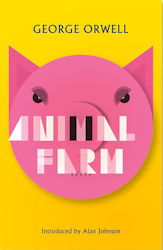 Animal Farm: PaperbackView on Amazon→
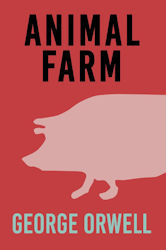 Animal Farm - Kindle EditionView on Amazon→
As an Amazon Associate, Fictiq earns from qualifying purchases.