Author: William Shakespeare
First Performed: c.1606
Genre: Tragedy / Historical Drama
Level: GCSE English Literature (AQA, Edexcel, OCR, WJEC)
Setting: 11th-century Scotland
⭐ Why It Matters
One of Shakespeare’s most intense and studied tragedies, Macbeth explores ambition, guilt, fate, and power, all wrapped in dark, supernatural overtones. With vivid imagery, sharp pacing, and memorable characters, it’s a staple of the UK curriculum — perfect for analysing themes, symbols, and tragic structure.
The play was probably written during the reign of James I, whose interests and political concerns would have been familiar to Shakespeare’s audience. James had written about witchcraft and believed himself descended from Banquo, which may help explain the prominence of the witches and Shakespeare’s favourable portrayal of Banquo. The play also appeared shortly after the Gunpowder Plot of 1605, giving its treatment of regicide, treason and deceptive language particular urgency.
Shakespeare drew the story from Holinshed’s Chronicles but changed the history considerably. The real Macbeth killed Duncan in battle rather than murdering him as a guest, and then ruled Scotland for many years. Shakespeare reshaped these events into a concentrated tragedy about temptation, unlawful power and the psychological destruction caused by violence.
👥 Main Characters
- Macbeth – A Scottish general, brave in battle but fatally ambitious.
- Lady Macbeth – His cunning and manipulative wife, who pushes him to act.
- The Three Witches – Mysterious, prophetic figures who spark Macbeth’s descent.
- Banquo – Macbeth’s noble friend; the witches say his descendants will be kings.
- Fleance – Banquo’s son, who escapes Macbeth’s assassins and keeps the witches’ prophecy about Banquo’s descendants alive.
- King Duncan – The benevolent King of Scotland, murdered by Macbeth.
- Donalbain – Duncan’s younger son, who flees to Ireland after his father’s murder.
- Macduff – A Scottish nobleman who opposes Macbeth and ultimately defeats him.
- Lady Macduff – Macduff’s wife, abandoned in Scotland when he travels to England and later murdered on Macbeth’s orders.
- Malcolm – Duncan’s eldest son, rightful heir to the throne.
- Ross – A Scottish nobleman and messenger who witnesses the kingdom’s decline and eventually joins Malcolm against Macbeth.
📚 Plot Summary
🔹 Act 1 – The Prophecy
The play opens during a rebellion against King Duncan. Macbeth and Banquo, two of Duncan’s generals, distinguish themselves in battle against Scottish rebels and invading Norwegian forces. The former Thane of Cawdor has betrayed Duncan by supporting the enemy, so Duncan orders his execution and gives the title to Macbeth.
Before Macbeth learns of his promotion, he and Banquo encounter three witches on a moor. They greet Macbeth as Thane of Glamis, Thane of Cawdor and future King of Scotland. They also predict that Banquo will not become king, but that his descendants will. When Ross and Angus arrive and confirm that Macbeth has been named Thane of Cawdor, part of the prophecy is immediately fulfilled. Macbeth begins privately imagining the murder of Duncan, even though the witches have not told him to commit any crime.
Duncan later names his son Malcolm Prince of Cumberland, publicly establishing him as heir to the throne. Macbeth sees Malcolm as another obstacle between himself and the crown.
After receiving a letter describing the prophecy, Lady Macbeth fears that her husband is too compassionate to seize power through violence. She calls upon supernatural forces to remove her pity and begins planning Duncan’s death. When Duncan visits Macbeth’s castle at Inverness, Macbeth initially decides not to murder him. Lady Macbeth attacks his courage and masculinity until he agrees to carry out the plan.
🔹 Act 2 – Regicide
On the night of the murder, Lady Macbeth drugs Duncan’s guards while Macbeth prepares to enter the king’s chamber. Macbeth sees an imaginary dagger leading him towards Duncan, revealing how fear, ambition and the supernatural have begun to merge in his mind.
Macbeth murders Duncan while he sleeps but returns carrying the bloody daggers that were supposed to be left with the guards. He is too shaken to go back, so Lady Macbeth places the weapons beside the sleeping men and smears them with Duncan’s blood. Persistent knocking at the castle gate increases the sense that their crime has already begun to close around them.
A drunken Porter answers the gate, briefly imagining himself as the gatekeeper of hell. Macduff then discovers Duncan’s body. Macbeth kills the guards before they can defend themselves, claiming that grief and fury overwhelmed him, although his real purpose is to prevent them from being questioned.
Duncan’s sons fear that they will be the next targets. Malcolm flees to England, and Donalbain travels to Ireland. Their escape makes them appear suspicious, allowing Macbeth to take the crown. Macbeth is crowned at Scone, while Macduff pointedly returns to his own castle at Fife rather than attending.
🔹 Act 3 – Paranoia and Betrayal
Becoming king does not make Macbeth feel secure. He remembers that the witches promised a royal future to Banquo’s descendants and fears that he has committed murder only to place Banquo’s family on the throne. Banquo also suspects that Macbeth gained the crown dishonestly.
Without involving Lady Macbeth in the details, Macbeth hires assassins to murder Banquo and Fleance. Banquo is killed, but Fleance escapes into the darkness. The failed attempt leaves the prophecy unresolved and deepens Macbeth’s paranoia.
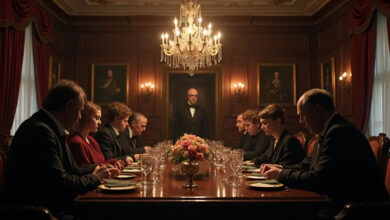
At a royal banquet, Macbeth sees Banquo’s ghost sitting in his place. No one else can see the apparition, and Macbeth’s terrified reaction alarms the assembled nobles. Lady Macbeth tries to dismiss his behaviour as a familiar illness, but the feast collapses into confusion. Whether the ghost is genuinely supernatural or a product of Macbeth’s guilty mind is never settled.
Macbeth now decides that violence must protect what violence has gained. Meanwhile, Scottish nobles begin to suspect him openly. Macduff has travelled to England, where he joins Malcolm and seeks military support from King Edward. Macbeth’s rule is becoming a tyranny, and organised resistance is beginning to form.
🔹 Act 4 – More Prophecies, More Madness
Macbeth returns to the witches and demands to know what the future holds. They summon three apparitions. An armed head tells him to beware Macduff. A bloody child declares that no one born of woman will harm him. Finally, a crowned child holding a tree says that Macbeth will remain undefeated until Birnam Wood moves to Dunsinane.
The first apparition increases Macbeth’s suspicion of Macduff, while the other two fill him with false confidence. He interprets their statements literally and assumes that every person is born of a woman and that a forest cannot move.
Macbeth then asks whether Banquo’s descendants will rule Scotland. The witches show him a procession of kings resembling Banquo, followed by Banquo’s ghost. The vision confirms that Macbeth may possess the crown temporarily but cannot create the lasting dynasty he desires.
After learning that Macduff has already fled to England, Macbeth orders an attack on his castle at Fife. Lady Macduff and her children are murdered, even though they present no political threat. The slaughter demonstrates that Macbeth is no longer killing reluctantly to gain power. He now uses violence instinctively against anyone connected to an opponent.
In England, Malcolm tests Macduff by pretending that he would be an even more corrupt ruler than Macbeth. Macduff’s despair for Scotland convinces Malcolm that his loyalty is genuine. Ross then arrives with news of the murder of Macduff’s family. Macduff turns his grief towards revenge, while Malcolm prepares to return with an English-backed army.
🔹 Act 5 – The Fall
At Dunsinane, Lady Macbeth is observed sleepwalking by a doctor and a gentlewoman. She repeatedly rubs her hands as though trying to remove Duncan’s blood and unknowingly reveals fragments of the couple’s crimes. The woman who once insisted that water would wash away their guilt now imagines that the blood and its smell can never be removed.
Malcolm’s army gathers near Birnam Wood. His soldiers cut branches from the trees and carry them as camouflage, concealing the size of the approaching force. From a distance, it appears that the wood itself is moving towards Dunsinane.
Macbeth continues to rely on the witches’ assurances, even as his supporters desert him. When he is told that Lady Macbeth has died, he responds with a bleak reflection on the emptiness and repetition of life. Her death takes place offstage, but Malcolm later reports that it is believed she took her own life.
A messenger announces that Birnam Wood appears to be moving. Macbeth finally recognises that the witches’ words may have deceived him, but he refuses to surrender. During the battle, he kills the young warrior Siward and still believes that no opponent born of a woman can defeat him.
Macduff then reveals that he was prematurely removed from his mother’s womb rather than delivered through an ordinary birth. Macbeth understands too late that the prophecy offered equivocal reassurance rather than genuine protection.
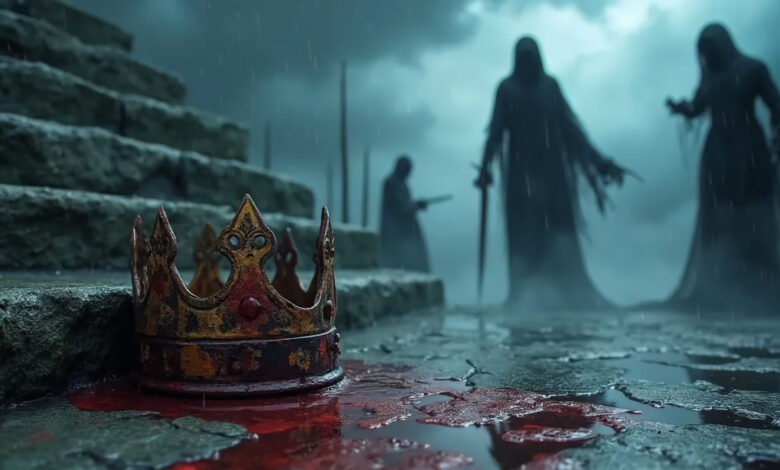
Macduff kills and beheads Macbeth. Malcolm is hailed as king and invites the nobles to see him crowned at Scone, restoring the lawful succession that Macbeth disrupted.
🧠 Themes & Takeaways
- Ambition & Power – Macbeth’s unchecked ambition leads to murder and madness.
- Fate vs Free Will – Are Macbeth’s actions predestined or chosen?
- Guilt & Conscience – Lady Macbeth’s descent into madness reflects the psychological cost of their crimes.
- The Supernatural – Witches and omens create a world where reality blurs with evil forces.
- Gender & Manipulation – Lady Macbeth challenges gender roles with chilling determination.
- Kingship & Tyranny – Duncan is a noble king; Macbeth becomes a murderous tyrant.
- Appearance vs Reality – Characters conceal violent intentions behind welcoming faces, while the witches use statements that sound reassuring but hide dangerous meanings.
- Violence & Masculinity – Lady Macbeth initially equates violence with courage, but Macduff later shows that grief, love and emotional honesty can also be forms of strength.
- Natural Order – Duncan’s murder is followed by darkness, violent weather and unnatural animal behaviour, suggesting that regicide has disturbed the order of the world.
- Blood & Sleep – Blood becomes a recurring image of guilt, while the loss of peaceful sleep reflects the psychological punishment suffered by Macbeth and Lady Macbeth.
Continue with the book
 Macbeth: GCSE RevisionView on Amazon→
 Macbeth: Complete Play & AnnotationsView on Amazon→
 Macbeth: PaperbackView on Amazon→
As an Amazon Associate, Fictiq earns from qualifying purchases.