Author: William Golding
Published: 1954
Genre: Allegorical Novel / Dystopian Fiction / Psychological Fiction
Level: GCSE English Literature
Setting: An uninhabited tropical island during an unspecified wartime evacuation
⭐ Why It Matters
Lord of the Flies examines what happens when the structures of civilisation disappear and a group must create its own rules. A party of British schoolboys survives a plane crash on an isolated island, but their early attempt to build an orderly society gradually gives way to rivalry, fear and violence.
Published less than a decade after the Second World War, the novel reflects William Golding’s increasingly pessimistic view of human nature. Golding had served in the Royal Navy and participated in the Normandy landings. His wartime experiences challenged the comforting assumption that education, social status or nationality automatically made people civilised.
The novel also responds to traditional British adventure stories such as R. M. Ballantyne’s The Coral Island, in which stranded boys demonstrate courage, Christian morality and supposedly superior British values. Golding deliberately overturns that optimistic tradition. His boys arrive with school uniforms, rules and confidence in their own upbringing, yet recreate many of the conflicts from which the adult world was supposedly protecting them.
The result is both an adventure story and an allegory about leadership, fear, mob behaviour and the fragility of democracy. It remains widely studied because its symbols are memorable, its conflicts are clear and its conclusions remain deeply unsettling.
👥 Main Characters
- Ralph – The elected leader of the boys. He values rules, cooperation, shelter and maintaining a signal fire so they can be rescued.
- Jack Merridew – The leader of a choir who becomes obsessed with hunting. His desire for authority develops into violent dictatorship.
- Piggy – An intelligent but frequently mocked boy whose practical thinking helps Ralph establish order. His real name is never revealed.
- Simon – A quiet and compassionate boy who understands that the feared beast may come from within the boys themselves.
- Roger – An initially withdrawn boy who gradually discovers that Jack’s tribe will allow him to behave with unrestricted cruelty.
- Sam and Eric – Identical twins, usually known collectively as Samneric. They remain loyal to Ralph until Jack’s tribe forces them to submit.
- The Littluns – The younger boys, who are frightened, vulnerable and increasingly neglected as the older boys struggle for power.
- The Naval Officer – The adult who appears at the end of the novel and fails to recognise the full significance of what has happened.
📚 Plot Summary
🔹 The Crash and the Conch
During a wartime evacuation, an aircraft carrying British schoolboys crashes on a tropical island. The adult pilot is killed, leaving the surviving children without supervision.
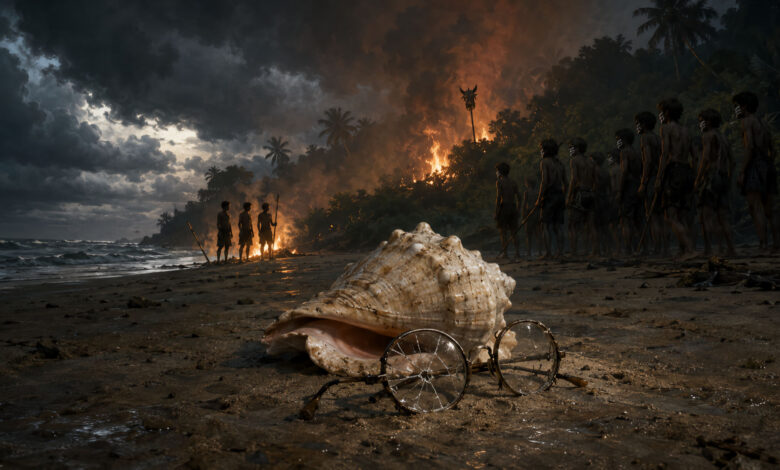
Ralph meets a boy whom the others later nickname Piggy. Piggy discovers a large conch shell and explains that it can be used as a trumpet. Ralph blows it, summoning boys who have been scattered across the island. Among them is a disciplined choir led by Jack Merridew.
The boys decide to elect a chief. Jack expects to be chosen because he already commands the choir, but the group elects Ralph, partly because he holds the conch that brought them together. Ralph attempts to reduce Jack’s resentment by allowing him to take charge of the choir, who become the island’s hunters.
Ralph, Jack and Simon explore the island and confirm that it is uninhabited. Their excitement initially makes the situation feel like an adventure, but Jack hesitates when presented with an opportunity to kill a trapped piglet. Embarrassed by his hesitation, he promises that he will not show such weakness again.
🔹 Rules, Shelters and Fire
Ralph holds meetings at which the boy carrying the conch is allowed to speak. He identifies rescue as their most important objective and insists that a signal fire must be maintained on the mountain.
The boys use Piggy’s glasses to focus the sunlight and start the fire. Their enthusiasm quickly becomes uncontrolled, however, and flames spread through part of the forest. A small boy with a mulberry-coloured birthmark, who had spoken of a snake-like beast, disappears and is presumed to have died in the fire.
Ralph and Simon begin building shelters, but most of the other boys lose interest. Jack becomes increasingly absorbed in tracking and killing pigs. The disagreement between Ralph and Jack reflects two competing ideas of leadership: Ralph concentrates on rescue and the needs of the group, while Jack offers excitement, meat and the promise of protection.
The younger boys continue talking about a beast living somewhere on the island. Ralph and Piggy dismiss the idea, but fear proves more powerful than reason. Jack begins to recognise that he can gain authority by presenting himself as the person capable of hunting the supposed creature.
🔹 The First Kill
Jack develops techniques for hunting and begins painting his face with coloured clay. The mask frees him from embarrassment and personal responsibility, allowing him to behave in ways that would previously have shamed him.
Jack and his hunters eventually kill a pig, but they have abandoned the signal fire to do so. While the fire is out, a ship passes the island without seeing them. Ralph is furious because an opportunity for rescue has been lost, but the hunters return chanting and celebrating their kill.
When Piggy criticises him, Jack strikes him and breaks one lens of his glasses. Although Jack apologises for allowing the fire to go out, his apology wins admiration and prevents Ralph from regaining complete authority. The hunters’ success also gives Jack something Ralph cannot provide: meat.
During their feast, the boys imitate the killing of the pig through a ritualised dance. What begins as a game becomes increasingly aggressive. Hunting is no longer simply a way to obtain food; it is becoming a source of identity, excitement and collective violence.
🔹 The Beast from the Air
One night, an aerial battle takes place above the island. A dead parachutist drifts down and becomes entangled on the mountain. The movement of the parachute in the wind makes the body appear to rise and fall.
Sam and Eric, who are tending the signal fire, see the shape in darkness and flee, convinced that they have encountered the beast. Their terrified account spreads quickly, giving the boys’ imagined threat an apparently physical form.
Ralph, Jack and Roger search the island and discover a rocky area that Jack later names Castle Rock. They eventually climb the mountain and see the parachutist from a distance. Unable to identify it in the darkness, they also believe that the beast is real.
Jack uses the failure of Ralph’s leadership to challenge him publicly. When the other boys refuse to remove Ralph as chief, Jack leaves the group and forms a separate tribe. Many of the boys gradually join him, attracted by hunting, feasting and freedom from work.
🔹 The Lord of the Flies
Jack’s tribe kills a nursing sow in an increasingly cruel hunt. They cut off its head and place it on a sharpened stick as an offering to the beast. The head soon becomes surrounded by flies.
Simon encounters the pig’s head while alone in the forest. In a hallucination, it appears to speak to him as the Lord of the Flies. The name refers to Beelzebub, a figure traditionally associated with evil. Simon understands that the beast is not an external creature that can be hunted and killed. It represents something frightening within the boys themselves.
After recovering, Simon climbs the mountain and discovers the dead parachutist. He frees the body from some of its tangled lines and realises that the boys have mistaken an ordinary corpse for a supernatural monster.
Simon rushes down the mountain to tell the others. Meanwhile, Ralph and Piggy have joined a feast held by Jack’s tribe. A storm begins, and the boys perform their hunting dance with increasing frenzy. When Simon emerges from the darkness, they mistake him for the beast and attack him as a group.
Simon is killed before he can explain what he has discovered. The storm carries the parachutist out to sea, while the tide takes Simon’s body away from the island.
🔹 The Tribe Takes Power
The following morning, Ralph recognises that Simon was murdered. Piggy insists that it was an accident caused by darkness, fear and the storm. Both struggle to admit their own participation in the dance.
Jack establishes himself at Castle Rock and rules through punishment and fear. Roger discovers that he can inflict pain without consequence, while Jack orders boys to be beaten for unexplained offences. The tribe has replaced the conch and open discussion with obedience to a single leader.
Although Jack’s group controls the meat, it cannot easily produce fire. The hunters raid Ralph’s camp during the night and steal Piggy’s glasses. Without them, Piggy can barely see, and Ralph’s group can no longer maintain a signal.
Ralph, Piggy, Sam and Eric travel to Castle Rock to demand the return of the glasses. Piggy carries the conch and attempts to appeal to the boys’ remaining sense of law and reason. He asks whether it is better to live by rules and cooperate or to hunt and kill.
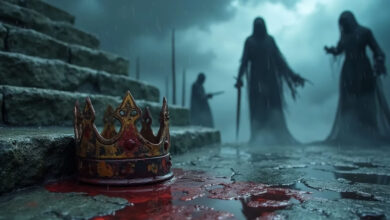
Roger releases a large boulder from above. It strikes Piggy, knocking him from the cliff and killing him. The conch shatters at the same moment, symbolically destroying the authority and civilised order it represented.
Jack throws a spear at Ralph, who escapes into the forest. Sam and Eric are captured, tortured and forced to join the tribe.
🔹 The Hunt for Ralph
Ralph is now alone. He secretly approaches Sam and Eric, who warn him that Jack intends to hunt him the following day. They also reveal that Roger has prepared a stick sharpened at both ends, suggesting that Ralph’s head will be displayed in the same manner as the sow’s.
The tribe searches the forest and sets it on fire to drive Ralph from hiding. The signal fire once intended to save the boys has failed, while the destructive fire intended to kill Ralph becomes enormous enough to attract attention.
Ralph runs towards the beach with the hunters close behind him. He collapses and looks up to see a British naval officer standing nearby. The officer has come ashore after seeing the smoke.
The boys immediately stop behaving like warriors and appear once again to be frightened children. The officer is embarrassed by their emotion and expresses disappointment that British boys could have allowed their society to collapse.
His reaction contains the novel’s final irony. He represents an adult civilisation engaged in a devastating war, yet fails to recognise that the boys have reproduced the same patterns of rivalry, fear and violence on a smaller scale. Ralph cries for Piggy, Simon and the loss of the innocence with which they first arrived.
🧠 Themes & Takeaways
- Civilisation vs Savagery – Ralph’s rules, the conch and the signal fire represent organised society. Jack’s tribe offers freedom from responsibility but replaces cooperation with violence and fear.
- Power & Leadership – Ralph seeks authority through elections and discussion, while Jack gains power by controlling food, promising protection and punishing opposition.
- Fear & Manipulation – The beast becomes politically useful to Jack. By claiming that only his hunters can protect the boys, he converts fear into obedience.
- Human Nature – Simon’s discovery suggests that the most dangerous beast does not live in the forest. Violence emerges from within the boys rather than from an external monster.
- Loss of Innocence – The island initially appears to offer adventure and freedom. The deaths of Simon and Piggy destroy that illusion permanently.
- Mob Mentality – Simon’s murder shows how individuals can surrender judgement and responsibility when absorbed into an excited and frightened crowd.
- Knowledge & Reason – Piggy’s intelligence is repeatedly ignored because he lacks physical confidence and social status. His glasses create fire, but others value the tool more than the person who understands it.
- Rules & Democracy – The conch has authority only while the boys collectively agree to respect it. Once Jack rejects that agreement, the object cannot protect Piggy or preserve order.
- Masks & Identity – Jack’s painted face allows him to escape shame and behave as part of a violent group rather than as an accountable individual.
- War & Adult Hypocrisy – The naval officer rescues the boys but belongs to a world fighting its own destructive conflict. The adult world is not a moral alternative to the island, only a larger version of it.
Continue with the book
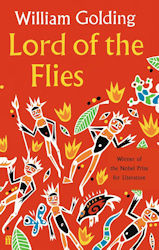 Lord of the Flies: PaperbackView on Amazon→
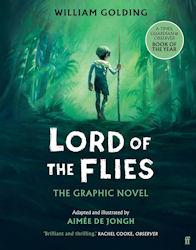 Lord of the Flies: Graphic NovelView on Amazon→
 Lord of the Flies: GCSE Text GuideView on Amazon→
As an Amazon Associate, Fictiq earns from qualifying purchases.